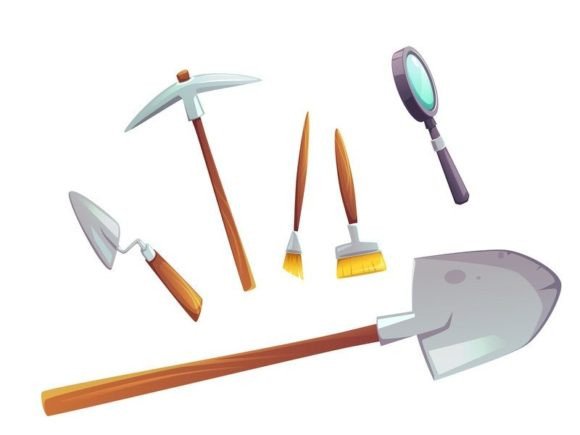
Excavation Tools Set of Cartoon Vector Illustrations
Visual storytelling often relies on the perfect icon to convey a complex idea instantly. When you need to represent archaeology, history, or discovery without using heavy photography, an Excavation Tools Set of Cartoon Vector Illustrations offers a vibrant and versatile solution. These digital assets transform the gritty reality of digging into a clean, engaging graphic style that works beautifully across various media. Whether you are designing an educational worksheet for children or creating a marketing campaign for a museum, these illustrations bridge the gap between technical accuracy and visual appeal.
The Core Elements of Archaeological Graphics
At its heart, this collection is more than just a random assortment of images; it is a curated toolkit designed to represent the scientific process of unearthing history. The set typically includes essential instruments like a shovel, trowel, pick, magnifier, and various brushes. Each item is rendered in a cartoon vector style, meaning they are composed of mathematical paths rather than pixels. This ensures that whether you shrink them down for a social media avatar or enlarge them for a billboard, the lines remain crisp and the colors stay true.
The isolation on a white background is a critical feature for designers. It allows for seamless integration into any project. You can drop a trowel onto a textured map, place a magnifying glass over a photo of ancient pottery, or arrange the entire set against a colorful gradient. The "cartoon" aspect does not imply childishness; instead, it suggests clarity and friendliness. It strips away the mud and dust associated with real excavation sites, leaving behind the pure silhouette and function of the tools themselves.
Why Designers and Educators Choose Vector Art
The decision to use an Excavation tools set of cartoon vector illustrations often comes down to flexibility and scalability. Unlike raster images (like JPEGs or PNGs), which lose quality when resized, vectors are infinitely scalable. For a small business owner creating a logo for a historical tour company, this means the shovel icon will look sharp on a business card and equally impressive on a van wrap.
Educators also find immense value in this format. When teaching students about how artifacts are discovered, realistic photos can sometimes be too cluttered or intimidating. A simplified, cartoon-style illustration highlights the specific tool being discussed without distraction. A teacher can easily color-code the brushes for delicate work versus the pick for breaking ground, making the learning process interactive and visually distinct.
Practical Applications Across Industries
The utility of these illustrations extends far beyond simple decoration. They serve as functional communication tools in diverse professional contexts. Here are several ways creators and professionals leverage this specific type of asset:
- Educational Materials: Textbooks, flashcards, and online courses use these icons to label diagrams of excavation layers or to illustrate safety procedures. The friendly style encourages engagement among younger learners.
- Museum and Heritage Marketing: Brochures, event posters, and website banners for archaeological digs often use these graphics to signal the theme immediately. A magnifying glass icon next to the text "New Discoveries" creates an instant association with investigation and detail.
- App and Game Development: Mobile games centered on history or puzzle-solving require UI elements that are clear at small sizes. The isolated nature of these vectors makes them perfect for inventory screens where players collect virtual shovels and brushes.
- Blog and Content Creation: Writers covering history or travel topics need unique visuals to break up text. Using a custom set of excavation tools adds a personal touch that stock photography often lacks.
Enhancing Brand Identity with Custom Imagery
For entrepreneurs and freelancers, consistency is key to building a recognizable brand. If you run a blog dedicated to local history or a startup focused on historical preservation technology, using a cohesive set of illustrations helps establish a unique visual voice. Instead of mixing and matching generic clip art, a dedicated Excavation Tools Set of Cartoon Vector Illustrations ensures that every piece of content feels part of the same family.
Consider a scenario where a marketer is launching a campaign for a new historical documentary. By utilizing the pick and trowel from this set, they can create animated intros, social media stories, and email headers that feel unified. The cartoon style allows for animation, adding movement to the static tools—a spinning magnifier or a sweeping brush—which captures attention in crowded digital feeds.
Key Considerations Before You Start
While these assets offer significant advantages, there are important factors to consider before integrating them into your workflow. First, ensure the license terms align with your intended use. Some vector sets are free for personal projects but require a commercial license for business applications. Always verify if you can modify the colors or shapes, as some licenses restrict alterations.
Second, think about the context of your audience. While the cartoon style is generally safe, certain professional environments might prefer a more realistic or minimalist line-art approach. However, even in corporate settings, a well-executed cartoon vector can soften a complex topic, making it more accessible to stakeholders who may not have a background in archaeology.
Finally, consider the technical requirements of your project. Ensure your design software supports vector formats like SVG, EPS, or AI. This guarantees that you retain the ability to edit individual strokes and fill colors later. If you are working with a team, having the source files allows for collaboration, enabling one person to adjust the handle of the shovel while another changes the bristles of the brush.
Maximizing the Impact of Your Visuals
To get the most out of an Excavation tools set of cartoon vector illustrations, don't just place the items randomly. Think about the narrative you want to tell. Grouping the trowel and brush together suggests precision and care, while placing the pick and shovel side-by-side implies heavy labor and initial breakthrough. Using the magnifier as a focal point can draw the viewer's eye to specific details in your layout.
Color psychology also plays a role. While the base illustrations might come in standard colors, vector art allows you to adapt them to your brand palette. A museum might choose earthy tones like terracotta and olive green, while an educational app might opt for bright primary colors to excite young users. The versatility of the vector format empowers you to tailor the aesthetics without losing the integrity of the original design.
In conclusion, these illustrations are more than just decorative elements; they are powerful tools for communication. By simplifying the complex world of archaeology into clear, scalable, and engaging graphics, they help creators, educators, and businesses connect with their audiences effectively. Whether you are explaining the delicate process of brushing dirt off a fossil or simply branding a history-themed event, the right set of vector tools can make all the difference in how your message is received.