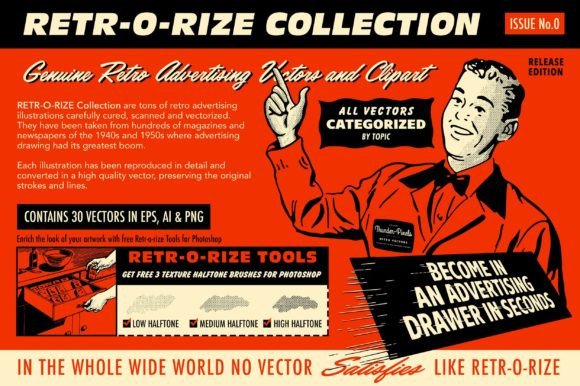
Retro Vectors Collection - Issue 0: Integrating Mid-Century Assets into Modern Design Workflows
In the fast-paced world of digital design, authenticity is a scarce resource. While modern vector libraries offer clean lines and perfect gradients, they often lack the tactile warmth and historical character that define effective nostalgic branding. This is where Retro Vectors Collection - Issue 0 enters the creative workflow. It is not merely a folder of clip art; it is a curated archive of advertising illustrations from the 1940s and 1950s, meticulously scanned, cleaned, and converted into high-quality vectors. For designers, marketers, and content creators, understanding how to integrate these assets into a broader production process can significantly enhance the visual impact of campaigns, editorial layouts, and brand identities.
The Value of Curated Historical Assets
The mid-twentieth century represented a golden age for advertising illustration. During this era, before photography completely dominated commercial art, illustrators relied on distinct stroke work, expressive linework, and bold compositions to capture attention. The Retr-o-rize Collection, from which Issue 0 is drawn, preserves this specific aesthetic. However, raw scans from old magazines are rarely ready for immediate use in professional projects. They often contain noise, inconsistent resolutions, or color shifts that require hours of manual correction.
By providing pre-vectorized assets, this collection removes the technical barrier to entry. Each of the thirty illustrations included in this release edition has been reproduced in detail, preserving the original strokes and lines. This level of fidelity allows professionals to scale graphics for large-format printing or shrink them for mobile interfaces without losing the integrity of the hand-drawn feel. When planning a project that requires a vintage touch, starting with high-quality vectors rather than low-resolution raster images saves considerable time during the execution phase.
Strategic Placement in the Design Process
Integrating retro assets requires more than just dropping an image onto a canvas. To maximize efficiency and maintain visual consistency, consider where these vectors fit within your typical project lifecycle.
Pre-Production and Concept Development
During the brainstorming phase, mood boards are essential for aligning stakeholders on a visual direction. Retro Vectors Collection - Issue 0 serves as an excellent foundation for establishing a mid-century tone. Because the collection includes diverse topics, you can quickly assemble concepts that blend lifestyle imagery with product-focused illustrations. Using these vectors early helps determine if the retro aesthetic aligns with the brand’s message before committing to custom illustration or extensive photo manipulation.
Production and Asset Assembly
Once the concept is approved, the vectors move into active design. Their compatibility with standard industry software means they can be layered, recolored, and masked seamlessly. For example, a marketer creating a social media campaign might use a vector of a 1950s automobile as a background element, overlaying modern typography and current promotional text. The clean paths of the vector allow for easy isolation of specific elements, such as removing a background figure to focus on a product. This flexibility supports rapid iteration, a critical component of agile marketing workflows.
Post-Production and Quality Control
Even with high-quality source files, final output requires attention to detail. The inclusion of textured dot halftone brushes in this release edition provides a crucial tool for unifying the look. Digital vectors can sometimes appear too sterile against printed paper or textured digital backgrounds. Applying the low, medium, or high-size halftone brushes adds a layer of analog imperfection that bridges the gap between the digital file and the vintage aesthetic. This step is vital for maintaining authenticity and ensuring the final deliverable feels cohesive rather than assembled.
Workflow Integration and Technical Considerations
To fully leverage the potential of this collection, it is important to understand how these assets interact with other tools and resources in your toolkit. The thirty vectors in Issue 0 cover a range of subjects, but future editions will categorize assets more specifically, including retro faces, women, men, children, automobiles, and sports. This structured approach suggests a long-term strategy for asset management.
- Organization: Create a dedicated library folder for retro assets. Tag files by theme (e.g., "automotive," "lifestyle") to ensure quick retrieval during tight deadlines.
- Color Management: While the vectors preserve original lines, you may need to adjust colors to match current brand guidelines. Use global swatches in your design software to update hues across multiple assets simultaneously.
- Layering: Combine vectors from this collection with modern photographic elements. The contrast between crisp, hand-drawn lines and high-resolution photography can create a dynamic visual hierarchy that draws the viewer’s eye.
For educators and publishers, these vectors offer a safe, copyright-cleared way to illustrate historical contexts without navigating complex licensing agreements for original magazine scans. Freelancers can use them to add unique value to client proposals, demonstrating an ability to blend historical charm with modern technical precision.
Enhancing Authenticity with Halftone Textures
A common pitfall when using vintage-style assets is over-polishing them. The charm of 1940s and 1950s advertising lies in its slight irregularities and the printing limitations of the time. The gift of three textured dot halftone brushes—Low, Medium, and High size—addresses this directly. These brushes are not mere afterthoughts; they are essential tools for simulating the offset printing process.
When preparing a vector for print, applying a medium-sized halftone brush to shadow areas can mimic the ink spread of older presses. For digital screens, a low-size halftone can add subtle texture without causing moiré patterns. Understanding which brush size to apply depends on the final output medium and the viewing distance. Testing these textures on small batches before full-scale implementation ensures consistent quality across all deliverables.
Planning for Future Scalability
Issue 0 is described as a release edition, implying that it is the first step in a larger series. For businesses and creators building a long-term brand identity, investing in this initial set provides a foothold in a growing ecosystem. As subsequent editions release categorized collections—such as specific demographics or industries—you can expand your visual library while maintaining stylistic consistency. This scalability is crucial for agencies managing multiple clients who may require different niche retro themes but share a common quality standard.
Moreover, the process of working with these vectors builds institutional knowledge. Teams learn how to best manipulate mid-century styles, how to balance retro elements with modern UX requirements, and how to efficiently use halftone textures. This accumulated expertise becomes a competitive advantage, allowing for faster turnaround times and higher quality outputs in future projects.
Practical Tips for Immediate Implementation
To get started with Retro Vectors Collection - Issue 0, consider these actionable steps:
- Audit Current Projects: Identify any ongoing campaigns or designs that could benefit from a nostalgic or human-centric touch. Look for opportunities where generic stock photos feel cold or impersonal.
- Experiment with Composition: Take one vector from the collection and place it in three different layouts: as a hero image, as a background pattern, and as a small accent icon. This helps you understand the versatility of the asset.
- Test Texture Application: Apply the included halftone brushes to a sample vector. Adjust opacity and blending modes to see how the texture interacts with different background colors.
- Document Your Settings: Once you find a combination of vector coloring and halftone texture that works for your brand, save these settings as a preset. This ensures consistency across team members and future projects.
By treating these vectors as integral components of a structured design process rather than decorative afterthoughts, you elevate the overall quality of your work. The careful curation and technical preparation behind the Retr-o-rize Collection provide a solid foundation for creativity, allowing you to focus on storytelling and strategy rather than technical cleanup. Whether you are a small business owner looking to add character to your packaging or a professional designer crafting a complex editorial spread, these assets offer a reliable, high-quality resource for bringing the past into the present.